
If you would like help setting up visual supports and routines that suit your child, our team at Nivera Child Development Centre, Kumbalam, Ernakulam, can assess your child and guide you through a practical plan. Contact us to book a consultation.
Written
for Nivera Child Development Centre by the Occupational Therapy Team
Reviewed by: Occupational Therapy Division, Nivera CDC,
Kumbalam, Ernakulam
The guidance below reflects how our occupational therapists screen hand skills in preschool-age children and advise parents.
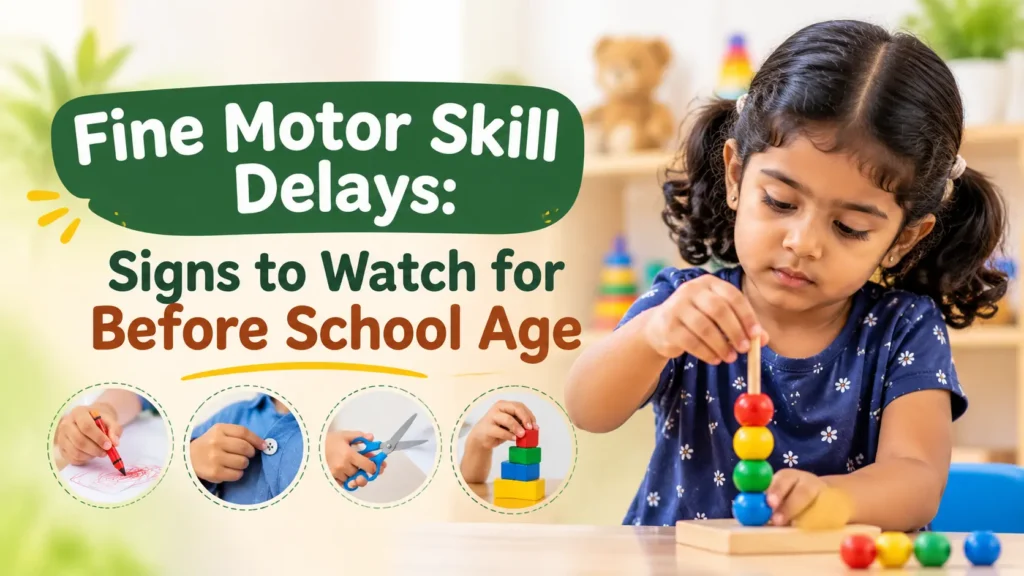
Before a child ever holds a pencil, they have spent years building the hand skills that make writing, dressing, eating, and playing possible. Fine motor skills are the small, precise movements of the fingers, hands, and wrists, working together with the eyes. When these skills develop more slowly than expected, the effects often show up at the school gate: a child who avoids drawing, struggles with buttons, or finds a tiffin box impossible to open. The encouraging news is that fine motor delays are common, recognisable early, and very responsive to support. This guide explains the milestones to expect, the signs of delay, common causes, and what parents in Kochi can do.
Fine motor skills use the small muscles of the hands and fingers, along with hand-eye coordination, grip strength, and finger control. They are different from gross motor skills, which involve large movements such as walking, jumping, and climbing. Fine motor skills include picking up small objects, stacking blocks, turning pages, using a spoon, holding a crayon, cutting with scissors, fastening buttons, and eventually writing. They develop step by step, building on a foundation of shoulder, trunk, and wrist stability, which is why a child who is wobbly through the body may also find hand tasks harder.
Children develop at their own pace, and the ages below are only a general guide. A child who is a few weeks or months behind on one skill is not necessarily delayed. What matters most is the overall pattern and whether progress is steady.
Around 6 to 9 months: reaches for and grasps toys, passes objects from one hand to the other, and rakes small items toward themselves.
Around 9 to 12 months: begins to pick up small items between thumb and finger (the pincer grasp), points with one finger, and bangs objects together.
Around 12 to 18 months: puts objects into containers and takes them out, scribbles with a crayon, stacks two or three blocks, and starts to feed themselves with fingers or a spoon, with spills.
Around 18 months to 2 years: stacks four or more blocks, turns pages of a board book, scribbles spontaneously, and may copy a straight line.
Around 2 to 3 years: strings large beads, unscrews lids, turns door handles, copies a circle by around 3, and makes simple snips with child-safe scissors.
Around 3 to 4 years: uses a more controlled pencil grip, cuts along a line, copies a cross, begins to use a fork, and manages large buttons and zips with help.
Around 4 to 5 years: draws a person with several body parts, copies a square, cuts out simple shapes, and starts to write some letters or their name.
Around 5 to 6 years: writes their name and letters with growing control, colours within lines, cuts out more complex shapes, and may manage buttons and shoelaces.
No single sign means a child has a delay, but a cluster of the following is worth discussing with an occupational therapist:
Difficulty picking up small items. By around 12 to 15 months, most children can pick up small things with thumb and finger. Ongoing struggles with this may be worth checking.
Keeping hands fisted. Hands that stay tightly closed past the early months, or a child who rarely opens their hands to explore toys.
A strong hand preference very early. Using only one hand before about 18 months can sometimes signal weakness or difficulty on the other side, and should be mentioned to your doctor.
Avoiding drawing, colouring, and craft. A child who walks away from table-top activities may be avoiding something that feels hard.
Awkward or very tight pencil or crayon grip. Holding a crayon in a fist well beyond the toddler years, pressing extremely hard or barely marking the page.
Struggling with self-care. Persistent difficulty using a spoon, fastening buttons, pulling up zips, or opening snack boxes compared with peers.
Difficulty with scissors or threading. Frustration with cutting, or inability to thread beads or lace cards when peers can.
Clumsiness and frequent dropping of items. Dropping cups, spilling often, or fumbling with toys.
Tiring quickly during hand activities. Shaking out the hand, complaining of aching fingers, or giving up after a short time.
Delay in other areas too. Fine motor delay sometimes appears alongside delays in speech, play, or gross motor skills, which makes assessment more important.
There is often no single cause. Several factors can contribute, sometimes together:
Low muscle tone or hypermobility. Loose joints and lower muscle tone make it harder to grip and control small movements.
Prematurity or early developmental history. Children born early, or with a complicated early start, may reach hand skills later.
Developmental coordination difficulties. Some children have a lasting difficulty with motor planning and coordination, sometimes called dyspraxia or developmental coordination disorder, which an assessment can explore.
Neurodevelopmental differences. Fine motor delays are more common in children with autism, ADHD, global developmental delay, and certain genetic conditions such as Down syndrome.
Sensory processing differences. A child who dislikes messy textures or has unclear touch feedback may avoid the hands-on play that builds fine motor skills.
Vision difficulties. Hand-eye coordination depends on how well a child sees, so vision problems can affect hand skills.
Limited hands-on practice. Children learn hand skills by using their hands. When much of the day is spent with screens or being carried, there are fewer chances to practise. This does not cause every delay, but it matters.
School asks a lot of small hands. Holding a pencil, copying from the board, cutting in craft time, opening a lunch box, using a zip, and managing a school bag all depend on fine motor skills. When these are difficult, children may tire quickly, avoid written work, produce messy handwriting, and feel left behind, even when their thinking is perfectly sound. Some children quietly lose confidence long before anyone notices the cause. Spotting and supporting fine motor delays in the preschool years gives children a stronger, calmer start.
Consider booking an assessment if your child:
Is not meeting several milestones for their age in hand use, or seems to be falling further behind.
Avoids or becomes upset during hand-based tasks such as drawing, building, or dressing.
Has a very awkward grip, or tires and gives up quickly.
Is approaching school age and you notice difficulty with scissors, pencils, buttons, or opening containers.
Has another diagnosis or delay such as autism, ADHD, Down syndrome, or prematurity, where hand skills often benefit from early support.
It is also worth speaking to your paediatrician if you notice weakness in one hand, loss of skills your child previously had, or very stiff or floppy movement.
An occupational therapist begins by listening to your concerns and learning about your child’s history, play, and daily routines. They then observe your child during play-based tasks, looking at grip, hand strength, finger control, hand-eye coordination, bilateral coordination (using both hands together), posture, and sensory responses. They may use structured developmental assessments suited to your child’s age. You then receive a clear explanation of your child’s strengths, areas needing support, and practical recommendations, which may include therapy, home activities, or a referral to another specialist such as a paediatrician or eye doctor.
Therapy is play-based and built around your child’s interests. It usually builds the foundations first, then the finer skills.
Strengthening the base. Activities that build shoulder, trunk, and wrist stability, since steady support makes the fingers more precise.
Hand and finger strength. Playdough, clay, pegs, tongs, and squeezing and pinching games.
Coordination and control. Threading, lacing, stacking, tearing and cutting activities that build precision and hand-eye coordination.
Grip development. Gradual, play-based guidance toward a more comfortable, efficient pencil grip.
Functional practice. Real-life tasks such as buttons, zips, spoons, and containers, so skills carry over into daily life.
Sensory support. Gentle exposure to messy and textured play for children who avoid it.
Parent coaching and a home programme. Short, enjoyable activities that fit into family routines.
Everyday life offers plenty of practice, and none of it needs expensive equipment. Always supervise, and keep small objects away from children under three because of choking risk.
Playdough and clay. Rolling, squeezing, pinching, and poking builds finger strength. Rolling small balls and pressing in beads is a favourite.
Kitchen helpers. Tearing greens, kneading chapati dough, peeling a boiled egg, stirring, and pouring from small jugs are brilliant hand workouts.
Sorting and picking. With supervision, older preschoolers can sort large items into bowls using fingers, spoons, or child-safe tongs.
Threading and lacing. Large beads, pasta tubes, and lacing cards are good for hand-eye coordination.
Drawing and kolam-style patterns. Finger painting, drawing in a tray of rice or sand, and tracing simple patterns build control.
Pegs and clips. Hanging small clothes on a line or clipping pegs to a card strengthens the pincer grip.
Cutting practice. Start with snipping strips of paper, then move to lines and shapes.
Vertical surfaces. Drawing on a wall-mounted board or paper taped to a wall strengthens the shoulder and wrist.
Dressing practice. Large buttons, zips, and velcro, practised calmly and without time pressure.
Reduce screen time. Replace some passive time with hands-on play, which helps most children.
At Nivera Child Development Centre in Kumbalam, Ernakulam, our occupational therapists assess your child’s hand skills, strength, coordination, posture, and sensory responses, and build an individual, play-based plan with clear, measurable goals. We coach parents in simple home activities, coordinate with speech-language and behavioral therapists when a child has wider needs, and work with schools so that support continues in the classroom.
If you would like help setting up visual supports and routines that suit your child, our team at Nivera Child Development Centre, Kumbalam, Ernakulam, can assess your child and guide you through a practical plan. Contact us to book a consultation.
Disclaimer
This article is for general informational and educational purposes only and does not constitute medical advice or a diagnosis. Milestone ages are approximate and children develop at different rates. If you notice weakness in one hand, loss of previously acquired skills, or unusually stiff or floppy movement, please consult a paediatrician promptly. For a full assessment, please consult the clinical team at Nivera Child Development Centre.
KOCHI, KERALA
Leave a Reply