
Speech Therapist vs OT vs Special Educator: Which Does Your Child Need First?

By Nivera Child Development Centre, Kochi|

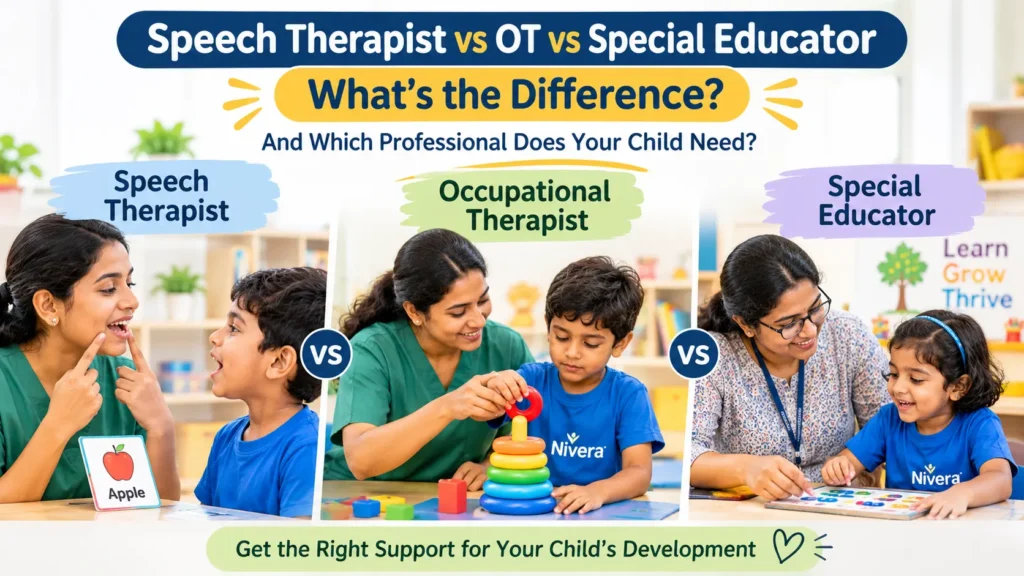
Comparison of a speech therapist, occupational therapist (OT) and special educator at Nivera Child Development Centre in Kochi, Kerala, showing how each professional supports children's communication, motor skills, learning and overall development.

You may have heard three different suggestions in one week: see a speech therapist, try occupational therapy, find a special educator. It is hard to know where to begin. This guide compares a speech therapist vs occupational therapist vs special educator in plain language. It shows which worry points to which professional, and why a joint assessment is often the safest first step. If talking is your main concern, you can also read about speech therapy in Kochi.

This article is for information only. It does not diagnose your child or replace an assessment by a qualified specialist.

Quick answer

Start with the professional who matches your child’s biggest daily difficulty. Choose a speech therapist for talking, understanding or feeding concerns. Choose an occupational therapist for handwriting, self-care, sensory reactions or clumsy movement. Choose a special educator for reading, writing, maths and classroom learning. If you cannot tell which fits, begin with a developmental assessment, because many children need two or three of them working together.

What each professional actually does

Each of the three works on a different part of your child’s day.

Speech therapist (speech-language pathologist). A speech therapist helps with talking, understanding language, clear speech sounds and stammering. ASHA describes these professionals as helping children with language, speech sound, stuttering and voice problems. Many also support feeding and swallowing. A child does not need to be talking to begin, because early goals often focus on any way to communicate, such as gestures, pictures or a device.

Occupational therapist (OT). An OT helps children manage the everyday jobs of childhood, such as dressing, eating, playing and writing. The American Academy of Pediatrics notes that children with developmental differences often find fine motor skills, sensory processing and motor planning hard, and that OTs can help. Typical goals include holding a pencil, using scissors and tolerating textures. You can see how this works in practice on our page for occupational therapy in Kochi.

Special educator. A special educator focuses on learning. They look at how your child learns, set goals for the classroom, and teach in ways adapted to your child. The Indian parent-support group Nayi Disha says special educators usually hold a B.Ed or M.Ed in Special Education and design individualised education plans. Learn more about special education in Kochi.

Which one first? Match the biggest worry

The simplest rule is to start where the daily struggle is greatest.

  • Not talking, or hard to understand: Start with a speech therapist and arrange a hearing check. Our guides on a 2 year old not talking and speech delay vs autism explain what to look for. If your home uses Malayalam and English, read what we say about a bilingual child and speech delay.
  • Struggling with buttons, scissors, pencils or balance: Start with an OT. Our guide to fine motor skill delays before school age lists the signs.
  • Strong reactions to sounds, textures, food or crowds: An OT is usually the right start. Our post on sensory seeking vs sensory avoiding helps you describe what you see.
  • Behind in reading, writing or numbers despite real effort: Start with a special educator, and ask whether a learning difficulty assessment is needed.
  • Meltdowns, attention or social worries: These may need a behaviour therapist or psychologist alongside the others. Read about behavioural therapy in Kochi to see how that support looks.
  • Several of the above at once: Ask for a joint assessment, so one team looks at the whole child.

Therapies are not a queue, and many children work with two or three professionals at the same time. Picture a four-year-old with very few words and very fussy eating. This is an illustrative example, not a real case. The speech therapist works on communication, the OT works on mouth and sensory skills, and both record progress in one plan.

Nivera’s approach is assessment first: initial assessment, therapy plan, parent guidance and progress review. Our team includes speech, occupational therapy and special education specialists, so one assessment can point to the right mix. For frequency and timelines, read how many therapy sessions a child needs.

Check hearing and general health first

Two checks come before, or alongside, any therapy: a hearing check and a paediatric review. ASHA lists signs of hearing loss, including not paying attention to sounds in babies, and audiologists are the specialists who test hearing. A developmental paediatrician can assess delays, autism, ADHD and learning differences, according to Nayi Disha.

If autism is one of your worries, our guide to the autism diagnosis process in Kochi explains the steps.

What about school?

If your child is already in school, the special educator is the link between therapy and the classroom. They can help plan goals, adapt tasks and talk with teachers. Our parent’s guide to IEPs for Kerala schools explains how an individualised education plan works.

A government reply in the Indian Parliament states that only a qualified special educator with a valid Rehabilitation Council of India (RCI) registration number can provide special education to children with disabilities. It is fair to ask any special educator for that number.

Costs, time and government options

Cost and duration depend on the plan, so ask for both in writing after the assessment. Our guide on autism and speech therapy cost in Kochi explains what families can expect.

Government District Early Intervention Centres under the RBSK programme screen and refer children, mainly at younger ages. Scheme rules change, so confirm current details with the official office.

Questions to ask before you choose

Any good centre will welcome these questions.

  • Qualifications: Speech therapists usually hold a BASLP or MASLP, OTs a BOT or MOT, and special educators a B.Ed or diploma in Special Education with an RCI number.
  • Assessment: Will you receive written findings and clear goals?
  • Your role: Will you get a home programme and parent guidance?
  • Teamwork: Do the therapists share goals and meet to review progress?
  • Review: When will progress be reviewed, and what changes if it is slow?

Frequently Asked Questions

Should my child see a speech therapist or an occupational therapist first?

See the one who matches your biggest worry. If your child is not talking or is hard to understand, start with a speech therapist. If the struggle is handwriting, dressing, fussy textures or clumsiness, start with an occupational therapist. If both are present, a joint assessment avoids guessing and lets the team plan one programme for your child.

Can a child have speech therapy and occupational therapy at the same time?

Yes, and it is common. Speech and OT goals often overlap, for example in feeding, attention and play. Good teams share goals and give parents one home plan, so the sessions support each other rather than compete. How many sessions each child needs depends on the assessment, so ask your therapist for a written plan and review date.

When does a child need a special educator instead of a therapist?

Consider a special educator when the main difficulty is learning rather than speech or movement. Examples include trouble with reading, spelling, writing or number work despite good effort, or a school asking for extra academic support. A special educator plans and teaches at your child’s level and can help build an individualised education plan with the school.

Should I get my child’s hearing checked first?

A hearing check is a sensible early step whenever speech or response to sound is a concern. Hearing loss can look like a speech delay or inattention, so ruling it out helps the team plan correctly. ASHA lists not responding to a name as one possible sign in babies. Ask your paediatrician to refer you to an audiologist, then share the result with your therapist.

Do I need a doctor’s referral before booking therapy?

Rules differ between centres and government programmes, so ask when you book. Even when no referral is needed, a paediatric check is wise to rule out medical causes and share any existing reports. Bring school feedback, earlier therapy notes and a list of your own concerns to the first visit.

Is a special educator the same as a school teacher or remedial teacher?

Not exactly. A special educator trains specifically in teaching children with disabilities and learning needs, usually through a B.Ed or diploma in Special Education. A remedial educator gives extra academic help, often one to one. A class teacher teaches the whole group. Ask any special educator for their qualification and, in India, their RCI registration number.

vision for your kid

Conclusion

There is no single right first step for every child. Match the professional to your child’s biggest daily difficulty, check hearing and general health, and ask for one combined plan if more than one area is affected. Therapy supports skills over time, and your questions and observations at home are a big part of that. If you are unsure where to start, an assessment gives you a clear answer and a written plan.

Disclaimer

This article is for general informational and educational purposes only and does not constitute medical advice, diagnosis, or a treatment plan. If your child is hurting themselves or others, or you are worried about their safety, please seek immediate help from a qualified professional or emergency service. Sudden changes in behaviour can also have medical causes such as pain or illness, so please consult a paediatrician. For guidance specific to your child, please consult the clinical team at Nivera Child Development Centre.

Leave a Reply

Your email address will not be published. Required fields are marked *

Open chat
Hello ????
Can we help you?